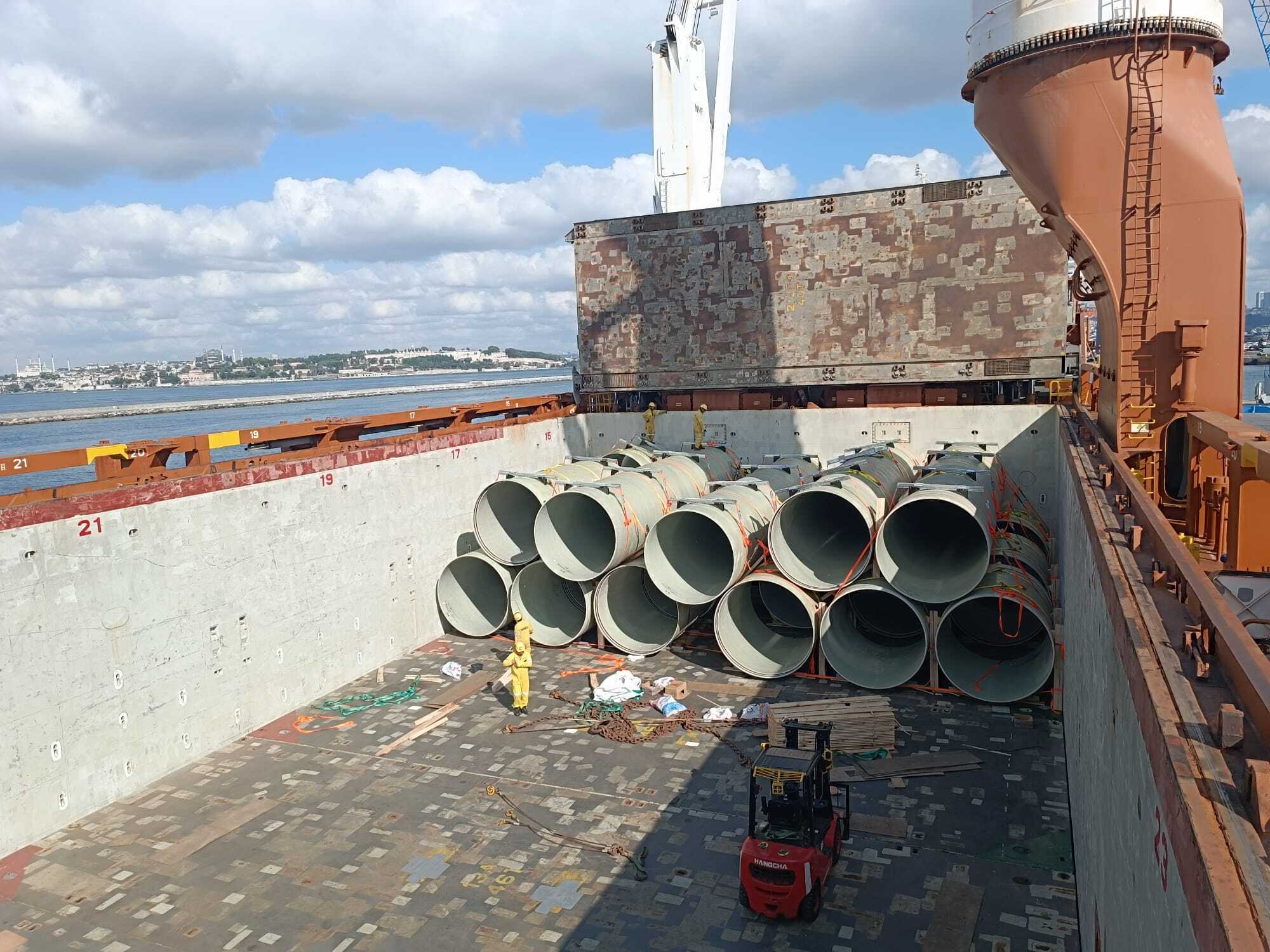
Engineering the Move: From Port to Project Site
1. Oversize Flat-Rack Cargo Required Equipment Engineering
One of the flat-rack shipments was particularly challenging because the cargo height was approximately 3.75 meters.
At that height, Beeontrade immediately recognized that conventional flatbed or normal step-deck planning might create unacceptable loaded-height exposure.
The team therefore evaluated:
- RGN / lowboy equipment,
- overall loaded height,
- bridge and overhead-clearance restrictions,
- permit routing,
- chassis and over-height handling,
- port flip requirements,
- and final-mile access into Forestburgh.
The internal planning explicitly identified that the increased cargo height could require special routing, bridge-clearance checks, lowboy/RGN equipment and higher permit costs.
This is an important distinction in project logistics.
The equipment is not selected because the cargo “looks oversized.”
It is selected after determining:
cargo height + trailer deck height + route clearance + permit requirements.
2. The Breakbulk Shipment Could Not Follow the Original Discharge Plan
For the Baltimore portion, the original concept included the possibility of moving some cargo directly from the vessel to waiting trucks.
However, once the terminal reviewed the final vessel operations plan, the strategy had to change.
The pipes were located in multiple positions aboard the vessel, and other cargo had to be discharged before them.
Canton therefore advised that direct discharge was no longer operationally necessary and that the pipes would instead be discharged to the terminal's place of rest and later loaded onto outbound trucks.
Beeontrade adjusted the operation immediately.
Rather than forcing the original plan, the team used the terminal staging period to improve the outbound delivery structure.
That became an advantage.
Once the pipes were on the pier, Beeontrade could control which exact pipe was paired with which truck.
3. We Challenged the Original Truck Count
The conservative planning approach could have resulted in approximately 38 truck movements.
Instead of accepting that number, Beeontrade examined the cargo at the individual-piece level.
The key question became:
How much of a standard step-deck can actually be used safely?
A standard 53' step-deck is not 53 feet of continuous usable lower deck.
The carrier confirmed approximately 43 feet of continuous usable lower deck, and specifically advised that certain shorter pipe types could be combined on one trailer.
Beeontrade then rebuilt the transportation plan using:
- actual Packing Nos.,
- actual individual pipe lengths,
- actual lower-deck geometry,
- cargo width and height,
- existing dunnage,
- and securement requirements.
The result:
48 pieces → 28 planned truckloads.
That optimization reduced unnecessary equipment without relying on unrealistic trailer assumptions.
4. Piece-Level Load Engineering
The final packing list contained pipes of different lengths.
Rather than simply classifying them as “long / medium / short,” Beeontrade converted the packing list into a physical loading matrix.
Each pipe received an operational control reference.
The master plan connected:
Packing No. → Piece ID → Load ID → Truck No. → Carrier → Terminal B# → Status
This allowed the team to determine exactly which pipes should move together.
Examples included:
- one long pipe per trailer,
- two compatible medium pipes on selected trailers,
- medium + short combinations,
- three shorter pieces where deck geometry allowed.
The longest combination loads were kept within the confirmed usable lower-deck envelope.
Most importantly, the terminal was instructed:
Do not substitute pieces between load groups without Beeontrade approval.
That single control prevents one of the most common project-cargo problems: a terminal loading the “same type” of cargo but selecting the wrong length, which can destroy the truck plan for later loads.
5. Trailer Selection Was Based on Real Geometry
The breakbulk pipes were too tall to simply use the upper deck of a standard step-deck as additional cargo space.
Beeontrade therefore treated the trailer as:
- 53' step-deck overall
- ≈ 43' usable continuous lower deck
The upper deck was excluded from the pipe-length calculation.
The team checked every planned combination against this real operating limit.
This meant Beeontrade could use standard step-deck equipment for the majority of the project rather than automatically buying more expensive stretch or extendable trailers.
Stretch equipment remained available as a contingency if actual securement spacing made a planned combination impossible.
This protected both:
- operational feasibility,
- and project cost.
6. Dunnage and Securement Were Reviewed Before Dispatch
The cargo photographs showed the pipes arriving with dunnage already banded to the cargo.
Because the pipe diameter was wider than the trailer deck, traditional pipe stakes could not necessarily be used in the normal way.
The trucking partner reviewed the photos and confirmed that the existing secured dunnage could prevent rolling, provided that each pipe was placed squarely on the dunnage during loading.
Beeontrade aligned:
- terminal,
- carrier,
- and internal operations
before trucks were released.
The operating rule became:
If any pipe arrived with missing, damaged, or different dunnage, the load would stop and be reviewed before dispatch.
This is the kind of small operational detail that prevents a major cargo claim later.
7. Terminal Negotiation Reduced Handling Cost
When direct discharge was removed from the operating plan, additional terminal handling could easily have become a major cost increase.
Beeontrade worked directly with Canton Stevedoring to restructure the handling solution.
Instead of simply accepting standard handling charges, Beeontrade negotiated a discounted all-inclusive terminal rate of USD 25.55/CBM, including wharfage, for moving the cargo to the terminal place of rest and later loading it onto trucks.
The revised basis was subsequently approved by the customer for execution.
This is an important part of the case study.
The operational change could have created additional cost.
Instead, Beeontrade:
redesigned the operation + renegotiated the terminal handling structure.
That is project management, not simply freight forwarding.
8. We Built a Controlled B# / Truck Release System
Canton's outbound process required each individual terminal load to receive its own pickup reference, or B#.
The carrier needed the B# both to schedule pickup and to get loaded.
Canton also operated within defined loading hours and required trucks to be scheduled by the prior business-day cutoff.
Beeontrade therefore built a controlled release workflow:
Packing No.
↓
Beeontrade Load ID
↓
Outbound instruction / BOL
↓
Canton B#
↓
Assigned carrier
↓
Truck scheduled
↓
Cargo loaded
↓
Jobsite delivery
Each B# was assigned to only one carrier.
No truck was supposed to be dispatched simply because cargo was at the terminal.
The carrier had to have the correct Beeontrade load allocation and the corresponding Canton pickup reference.
9. Truck Capacity Was Released in Controlled Waves
Rather than releasing all trucks simultaneously, Beeontrade planned the Baltimore outbound program in blocks.
The first operating concept was approximately five trucks per day, with terminal loading capacity and cargo availability confirmed before each wave. Beeontrade specifically asked Canton whether five outbound trucks per day was feasible and aligned the schedule around terminal loading windows and receiver coordination.
This prevented:
- truck congestion,
- excessive waiting,
- detention,
- terminal confusion,
- and too many oversized vehicles arriving at the jobsite simultaneously.
The first block was intended to validate the process.
Once the terminal, carrier and jobsite flow was proven, subsequent blocks could be released.
10. Multiple Carriers Were Managed Under One Control Plan
Capacity for a project this size cannot depend on a single truck appearing every morning.
Beeontrade evaluated multiple specialized carriers and ultimately structured carrier allocations while keeping one centralized load plan.
Current project coordination records show the 28 loads being divided between specialized trucking providers rather than depending on one source of capacity.
The important point was that carriers did not independently decide what cargo to pick up.
Beeontrade controlled the load allocation.
That maintained one operational truth across:
- terminal,
- carrier,
- customer,
- and jobsite.
11. Jobsite Coordination Was Treated as Part of the Transportation Scope
The Forestburgh site was not simply an address on a rate confirmation.
Beeontrade coordinated final-mile deliveries with the receiving side and requested direct site-contact information to manage deliveries.
The flat-rack phases had already required jobsite delivery coordination, and the later Baltimore breakbulk program had to be integrated around the same receiving operation.
This created a broader project-control function:
- port availability,
- truck release,
- transit timing,
- site receiving capacity,
- unloading readiness,
- and sequence of arrivals.
The objective was to avoid a situation where the port and trucking operation performed perfectly but the jobsite became the bottleneck.
12. Parallel Flat-Rack Execution Through New York/Newark
Before and alongside the breakbulk phase, Beeontrade was already coordinating flat-rack cargo into the Forestburgh location.
One program involved 13 × 40FR units moving from the New York gateway to the same project site. Internal project records show trucks being prepared ahead of arrival and the operations team coordinating final delivery with the U.S. project contacts.
Another flat-rack shipment presented a significantly different engineering problem:
1 × 40FR / approximately 3.75 m cargo height.
That load required analysis of:
- over-height terminal handling,
- chassis flip,
- lowboy/RGN feasibility,
- permit routing,
- bridge clearance,
- and final-mile route restrictions.
The fact that all of these shipments served the same jobsite allowed Beeontrade to apply lessons from one phase to the nextŞ